
The Right Shape
Rails engines for the age of coding agents
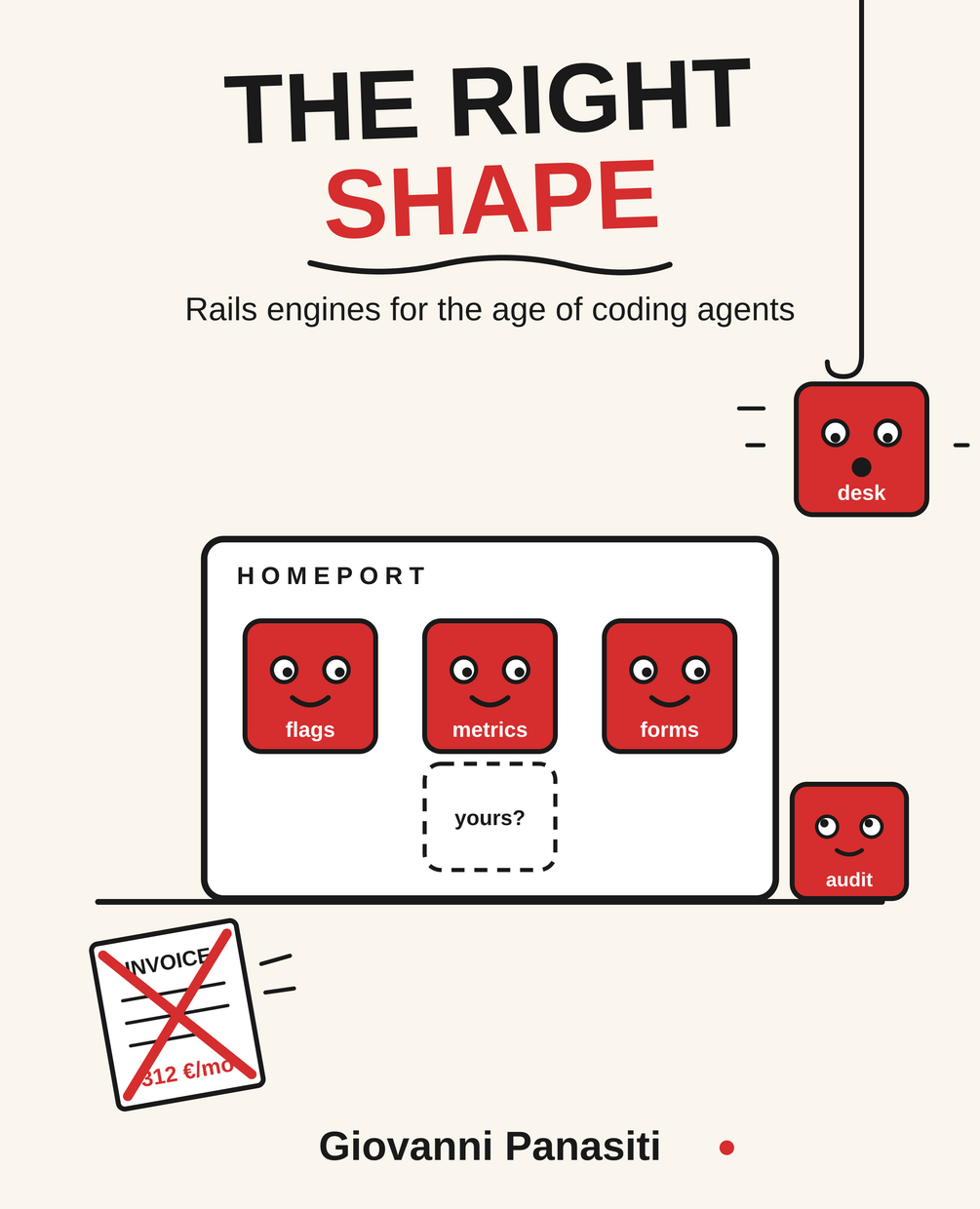
Coding agents made it cheap to rebuild the small SaaS tools your app depends on: feature flags, analytics, forms, a helpdesk. But most people rebuild them in the wrong shape. One new app per tool, one new deployment per tool, one new database per tool. That turns a subscription bill into an operations bill.
The right shape already ships with Rails: the engine. One host application, one deployment, one database server. Every feature you take back from a vendor becomes a mounted engine with its own repository, its own tests, and its own agent working on it.
This book builds that fleet, on the page, engine by engine.
What you build
- homeport, the host application. Rails 8.1, SQLite, Solid Queue, one server.
- active_flags, a feature-flag engine, built by hand so you learn every file.
- active_metrics, a privacy-first analytics engine. No cookies, no npm dependencies.
- active_forms, a forms and survey engine. Rendering in host pages, extension points, file uploads.
- active_desk, a support-desk engine, built by coding agents from a written spec, with the full session log and the real token cost.
- active_audit, extracted from the host with the strangler pattern.
Every chapter that writes code has a frozen chapter-NN git branch. Every code block in the
book matches its branch exactly.
What you learn
- What an engine really is. The book opens with a 19-line engine written by hand, no generator.
- Namespaces, migrations, mounted dashboards, and the classic
main_approute helper bug. - The public facade pattern: the one part of an engine the host may touch.
- Middleware, jobs, assets, and Active Storage inside an engine.
- Authentication at the boundary: engines do not own identity.
- Why an engine is the right unit of work for a coding agent: a bounded context that fits in a context window, with a test suite as the leash.
- How to review agent output, and when to throw a branch away.
- The honest comparison: engines against Packwerk packs, microservices, and a plain monolith. Including when an engine is the wrong choice.
- Shipping: gemspec hygiene, versioning, upgrades, operating the fleet, and responding to a real CVE.
I’ve spent years building engines in production, from Active Storage Dashboard to ActiveCanvas, and talking about them at conferences. This book is everything I know about the shape, written down.
Stop renting software you can now build.