
SaaS Is Dead, Long Live the License
By Giovanni Panasiti
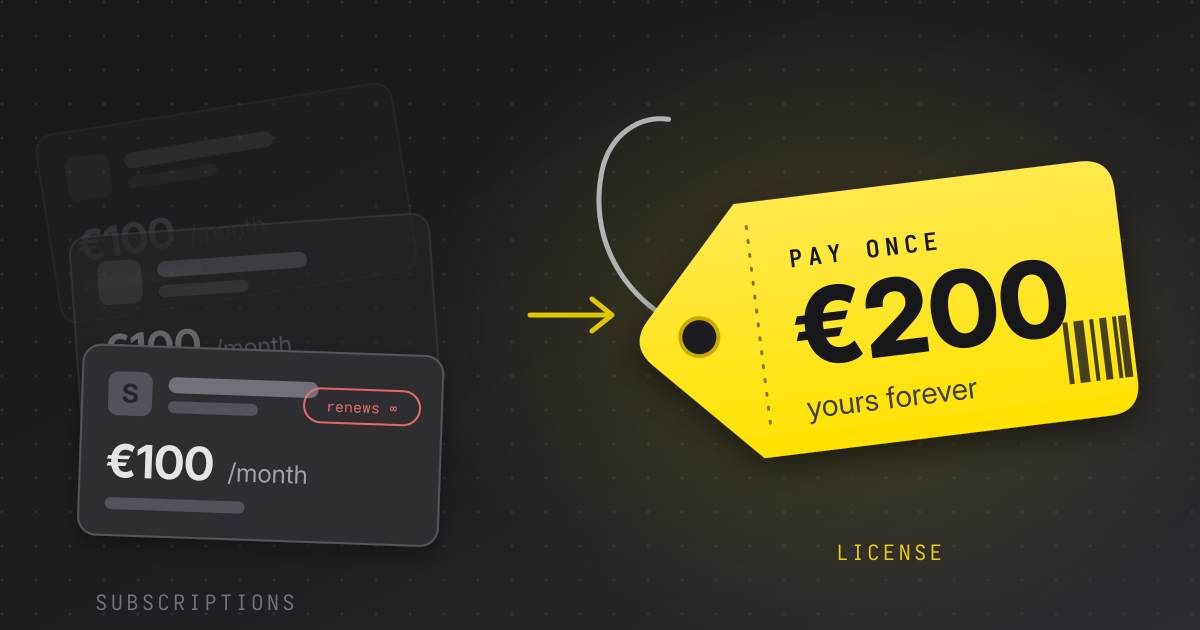
We hear every day the SaaS model is in serious trouble and the reason is vibecoding.
Let me explain, because I do not fully agree with the direction things are taking. But I think the direction is clear and the pay-once model is coming back.
The 100 euro per month problem
Take a classic example: a CRM. A decent one costs you 100 euros per month, sometimes more, often per seat. You pay it in January, you pay it in December, you pay it again next year. After three years you have spent almost 4,000 euros and you own nothing. If you stop paying, the software disappears and your data becomes a CSV export, if you are lucky.
Now put an AI coding agent in the hands of that same customer. Suddenly a lot of people look at that 100 euros per month and think: wait, I could describe what I need to Claude and get my own CRM. Not a general one built for ten thousand companies. One built exactly for my process, my fields, my weird workflow that no SaaS ever supported without three plugins and a Zapier subscription (at this point the user should ask himself some questions I think, but this will be another post).
I’ll be honest: I disagree with this reasoning. I build software for a living and I know what happens after the first version. Someone has to handle backups, security, migrations, the bug that only appears on the last day of the month. A vibecoded CRM is a puppy. It is cute on day one and then you have to feed it for years. Most people who vibe code their internal tools will discover this the hard way. Coding has always been the easiest part even when we used to do it manually
But my disagreement does not matter. It is happening anyway. People are doing this math right now, and for expensive subscriptions the math often wins against my objections. That is just a fact, and pretending otherwise is how you get surprised by the market.
The 200 euro question
So if vibecoding is eating the expensive subscriptions, is all commercial software dead? I do not think so. Actually, I think the opposite is about to happen at the low end of the price range.
Here is the question that changed my mind. Say there is a piece of software that costs 200 euros. Not per month. Once. You pay, you get a license, it is yours forever.
Would you vibe code your own version of that?
Think about what “vibe coding your own version” actually costs. 200 euros is one month of Claude Max. So to break even you need to build your replacement in less than one month of subscription, and that assumes your time is worth zero. It is not. You will spend evenings prompting, testing, fixing, deploying somewhere, and then maintaining the thing. All of that to avoid a one-time payment that costs less than a dinner for four in Rome.
For 100 euros per month forever, the vibecoding gamble can make sense. For 200 euros once, it is a terrible trade. You are spending tokens and time to badly rebuild something you could simply own.
Long live the license
This is why I believe we will see the return of a market that we almost killed, specially for solo developers: software you buy once. A license, a download, done. The model our industry abandoned because recurring revenue looks better in a pitch deck.
The economics of the seller change too, and here AI helps again. The main justification for subscriptions was always the ongoing cost: servers, support, a team that has to eat every month. But if one developer with AI tools can build and maintain a product that used to require a team of five, the pressure to charge monthly goes down. A solo developer can sell a 150 euro license, sell enough of them, and still sleep at night. The amount of product one person can maintain today is not comparable to five years ago.
There is also a trust element. People are tired. Every app wants 9.99 per month, every tool becomes a subscription, and your bank statement looks like a graveyard of forgotten trials. A product that says “pay once, it is yours” is not just cheaper over time. It is a statement of respect. In a world where everything rents, ownership becomes the premium feature.
DHH said this more than 2 years ago: https://world.hey.com/dhh/campfire-is-once-1-d2cebd12
Where this leaves SaaS
To be precise, I do not think every SaaS dies. Software that is genuinely a service survives: anything with heavy infrastructure, network effects, data that must live in the cloud, or compliance that changes every year. Nobody will vibe code their own payment processor (hopefully), and nobody should.
The SaaS that dies is the one that is just software with a rent attached. A form builder. A note app. A simple CRM. An invoice generator. Anything where the monthly fee exists because “that is the business model now” and not because running it actually costs money every month. Those products are squeezed from two sides: vibecoding from above, because the subscription is expensive enough to justify building your own, and pay-once licenses from below, because someone will sell the same thing for the price of two months of your subscription.
My bet for the next few years is simple. The subscription graveyard grows, vibecoded internal tools multiply and then rot quietly inside companies, and somewhere in the middle a new generation of small software vendors rediscovers an old idea: make a good product, put a fair price on it, sell it once.
I would happily pay 200 euros for software that respects me. I already pay that for the tokens. At least the license does not expire at the end of the month.